Health? or Hype?
Make the right choice with recommendations you can trust, backed by expert testing.
Explore health recommendations

Vegetables give us vitamins, minerals and fibre, can help with weight control and reduce our risks of many chronic diseases – they're also delicious.
Many of us are eating more of them too, according to a government survey, which suggests 32% of people surveyed have started eating more fruit and vegetables in the past 12 months.
There are many reasons why you might be incorporating more veg into your diet: health and nutrition, the cost of meat and concern for the planet. Growing your own can also be uniquely satisfying – if you're interested in getting started, read our piece on the five easiest vegetables to grow.
We've looked at how different appliances can cook cheap and tasty vegetable dishes that can save you money and benefit your health. Read on to find out more about your options and how they compare for energy costs.
Make the right choice with recommendations you can trust, backed by expert testing.
Explore health recommendationsBest used for: roasted and baked vegetables

Air fryers use hot air to cook food, meaning you can get away with very little or – sometimes – no oil. That's why air fryers are often marketed as 'health fryers'. And while some of those claims may be exaggerated, air frying your food is significantly healthier than frying it.
When air fryers first came on the scene they were popularly used for potatoes, but they're extraordinarily versatile devices. You can also use an air fryer to cook Brussels sprouts, broccoli, peppers and beetroot for example.
There can be time and cost savings from cooking with an air fryer, too.
When we compared baking a potato in an air fryer and a built-in electric oven, the air fryer was cheaper, costing only 10p in energy (19p less than the oven).
If you're cooking for a large number of people, you may find yourself limited on space with an air fryer.
Despite the name, air-fried food tends to taste baked or roasted rather than fried. That's perfectly fine if it's what you're aiming for.
If you're looking for an air fryer to feed a large group of people, head to our air fryer reviews and filter by 'large' capacity. Or Join Which? to get access to all our Best Buys and reviews of air fryer brands including Ninja, Tefal and Tower
Best used for: Stews, soups, curries, and steaming and roasting vegetables

A pressure cooker works by trapping steam and energy inside, flash-cooking food at a high temperature. Pressure cookers are incredibly convenient when you want a meal but don't have a lot of time to spare.
Plus, all your cooking is done in one pot.
Our test of different ways to steam vegetables found the cost differences between an induction hob, microwave and pressure cooker were negligible: 5p for an induction hob, 2p for a microwave and 5p for a pressure cooker.
| Induction hob | Microwave | Pressure cooker | |
| Cooking time | 9 minutes | 5 minutes | 12 minutes |
| Energy used to cook | 0.19 kWh | 0.86 kWh | 0.2 kWh |
| Cost to cook | 5p | 2p | 5p |
| Saving (compared to hob) | N/A | 3p cheaper | N/A |
| Quality of cooking | 4 – a little too firm | 4.5 – slightly overcooked | 4.5 – slightly overcooked |
It's easy to overcook vegetables in a pressure cooker, so check the instructions that come with your model.
The best pressure cookers are easy to use and produce delicious food quickly. Read our reviews to find the ones we rated
Best used for: Soups (obviously) but also sauces
Soup is a quick, easy and nutritious meal and there are plenty of vegetable-based soup recipes – tomato, mushroom, carrot and coriander, leek and potato and spicy pumpkin are some of the best known.
An easy way to add healthy protein into your dish is to use tinned legumes, such as beans or lentils. While some people prefer to do it the traditional way with pots, pans and blenders, a soup maker blends and cooks food in one go. You should be able to go off and do other things and return to find a delicious jug of soup. Some soup makers even have a self-cleaning function.
Soup makers are also cheap to run. If you were to make soup once a week using a soup maker, a soup maker would cost between £1.60 and £5.43 in electricity per year.
Aside from the cost and potential inconvenience of buying and storing another appliance (which also applies to air fryers, pressure cookers and slow cookers) there aren't any major disadvantages.
Many people find the process of making soup on the hob relaxing, and standing by the pot allows you to adjust the spices, seasoning and smoothness to suit your taste. If this is you, a soup maker might not be something you need.
Discover the best soup makers tried and tested by our experts, and find out how soup makers from Lakeland, Morphy Richards, Ninja, Tefal and other brands compare
Best used for: Steaming vegetables, reheating dishes, cooking jacket potatoes and warming tinned vegetables

Microwaving is quick and easy. You can steam vegetables in the microwave by adding a little water and covering with a lid to keep the steam in.
Don't worry that this will destroy the nutrients in your veg. Harvard Medical School has found microwaves' shorter cooking times do a better job than regular ovens of preserving vitamin C and other nutrients that break down when heated.
The research also found steaming vegetables using the microwave with a small amount of water keeps in more vitamins and minerals than almost any other cooking method.
Microwaves are energy-saving appliances too. In our tests of different ways to bake a large potato, a microwave was the quickest and cheapest appliance, while the oven took the longest amount of time and used more than six times more energy.
A microwave is also handy for warming up tinned vegetables in a microwave-safe dish. These make a cheap, quick and easy addition to a meal.
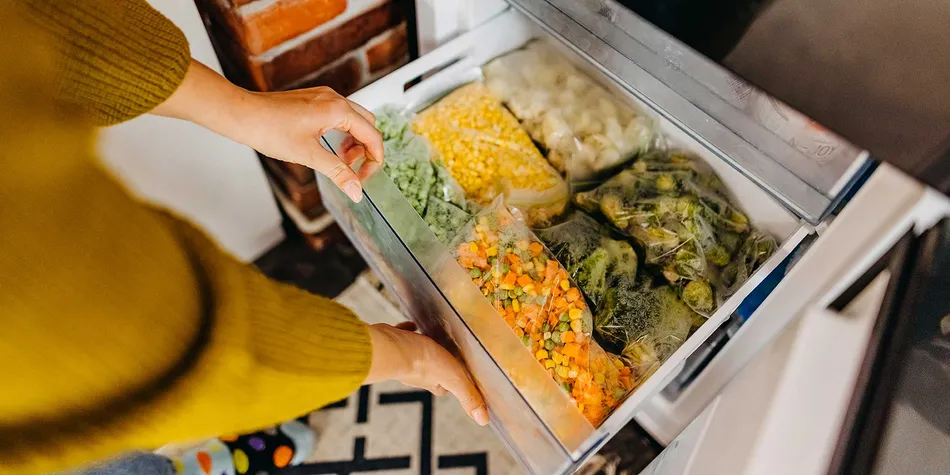
And, of course, microwaves are ideal for warming up leftovers. Many vegetable-based dishes keep really well in the fridge or freezer. Find out more about how to freeze and defrost food – including mushrooms – safely.
Our fridge freezer reviews reveal the models with good vegetable drawers that will keep your fruit, veg and salad nice and crisp vs those that will dry it out, or let it go warm, limp or icy
Our testers preferred the taste of steamed vegetables prepared on the hob to the taste of vegetables steamed in the microwave.
As for baked potatoes, an oven or an air fryer gives a jacket potato a nice, crispy skin which you won't get to the same extent in a microwave.
Microwaving food can also dry it out, so make sure to cover it.
Find out what you can and can't microwave, plus how to buy the best microwave if you're in need of a new one.
Best used for: Stews, preserves, chilli, soups and in some cases steaming
Slow cookers can produce succulent stews with minimum fuss and low running costs. Although cooking stew on a hob was cheaper than the slow cooker when we compared different methods, our experts agreed the stew produced by the slow cooker was tastier.
Running costs can vary. Some slow cookers cost between 2p to 7p per hour on their lowest setting, and from 4p to 33p an hour on their most energy intensive settings.
Our round up of the best slow cookers shows how much each one costs to run
Best used for: Anything you can cook in a pan – stews, curries, sauces, soups, steamed or boiled vegetables

Induction hobs now rival gas hobs for popularity – and with good reason. They're quick to heat food and respond rapidly when you turn them up or down.
While both induction hobs and traditional electric hobs use the same kind of energy and often look similar, they work differently.
Induction hobs generate heat in the pan itself; no heat is produced unless the pan is in contact with the hob surface. That makes induction hobs a cheap way to cook vegetables.
Most induction hobs simmer really well, making them ideal for slow-cooked dishes such as casseroles and curries. An induction hob also uses energy more efficiently than either a gas or electric ceramic hob, saving you money.
Our experts thought the induction hob produced a thinner stew than a slow cooker in their testing.
Also, if you’re a fan of frying – if you want to stir fry some vegetables for example – be aware this isn't an area where induction hobs excel. For top frying results, a heating zone or burner should be a consistent temperature all the way across. Many gas hobs do this better – although it's worth checking out our Best Buy induction hobs, several of which are bucking the trend and scored five stars in this area.
If you have a pacemaker, you shouldn’t get an induction hob as it generates an electromagnetic field that can interfere with pacemaker settings.
Thinking of switching to an induction hob? Read our guide to 5 things you should know before switching to an induction hob. And find the best induction hobs that aced our tests


The best way to cook vegetables will ultimately come down to what you're cooking and how much importance you place on convenience versus cost and flavour.
While you can make considerable energy savings with an air fryer or pressure cooker, there's an upfront cost involved in buying one in the first place.
If you regularly cook for a large group of people, or you tend to cook vegetables alongside other dishes, an oven may well be the best option. In addition to traditional roasting, some ovens also come with built-in steam oven and air fryer functions. Using pre-set timed programs can help you economise and get the best results without overcooking.
Whatever method you choose, we'd echo Delia Smith's advice that the perfect way to cook vegetables is 'carefully'. She recommends sliding a small flat skewer or sharp paring knife into the thickest part of the vegetable; you can feel if it's tender by the amount of 'give'. 'If you practice the skewer test every time you cook vegetables, you'll soon get the feel of catching the moment,' she says.