James Rowe: Discover emerald pools, enchanting hamlets and a fairy-tale castle in this desirable getaway spot.
Hello, I'm James Rowe and welcome to Which? Shorts, your free weekly insight into Which? magazine, as well as our money, tech, travel, and gardening titles, too.
Today, I'm bringing you a piece that our travel expert, Jo Rhodes, wrote for the May/June issue of Which? Travel all about her experience in Slovenia.
The former Yugoslav country may not be top of your wish list for upcoming getaways, but Jo's experience may convince you to make the two-hour-or-so flight to this mostly forested land. Here, Jo shares her review of Slovenia, from its lakes, castles, and stunning views.
Here's Jo's piece, adapted for the podcast, this week read by Jo herself.
Jo Rhodes: Sunlight streams through the windows, bathing the Mother of God statue in a celestial glow. Straining on my tiptoes, I reach for the rope dangling in front of the gilded altar and tug.
The cord is heavier than expected, but the bell sounds a throaty clang. A second and third peal reverberate in the hushed nave. Closing my eyes, I make a wish.
I am inside the Church of the Assumption of Mary, which crowns the tiny, tear-shaped islet on Lake Bled. A chapel has stood in this same spot for a thousand years, rebuilt after earthquakes and lightning strikes.
Most recently resurrected in Baroque style and topped with a 52-metre copper spire, it's the handsome poster child for Slovenia that graces so many travel blogs and Instagram posts.
Catholicism is the main religion in Slovenia, and naturally, Bled Island – which is just an hour's drive from Slovenia's capital, Ljubljana – is a popular spot to get wed. But there's a kicker.
To secure a long and happy marriage, it's traditional for the groom to carry his new bride up the 99 stone steps that lead from the jetty to the church entrance. It's no surprise that a place as fairy tale as this is steeped in folklore. A young widow, Poliksena, who lived at Bled Castle in the 16th century, is said to have had all her silver and gold cast into a bell in her late husband's memory. But the bell was lost during a storm while it was being moved across the lake.
The heartbroken Poliksena went to live in a convent in Rome and the Pope, moved by her story, consecrated a new bell and sent it to Bled, where it remains to this day.
Ring it three times and you will be granted a wish – as long as you believe in God.
And if anything will convince you of the existence of a higher power, it's spellbinding Bled.
The glacial lake, fed by thermal springs, was formed during the last ice age. It's the fine sediment particles in the meltwater that scatter light, giving the water its vibrant cyan colour. The forested Julian Alps are its backdrop, their craggy tips still sprinkled with snowfall during my visit.
Adding further drama, Bled Castle clings precariously to a 130-metre-high cliff top on the lake shore. Locals say that on a still night, you can hear the widow's sunken church bell ringing from the bottom of the lake. But it has competition.
I climb the belfry, where a pendulum clock of forged iron chimes every 15 minutes. I've timed my visit to coincide with the extra long and loud cacophony on the hour. A pigeon perched on the rafters flees in a flap of panic.
My farewell is more reluctant, back at the jetty where I board a motorboat. Halfway across the lake, I spot a pletna – a traditional flat-bottomed wooden boat. An oarsman stands on the stern, expertly slicing the water with two paddles. It's similar to a Venetian gondola – minus the eye-watering price. A round trip to Bled Island costs just €18.
Back on shore, I go in search of another Bled institution: the kremna rezina. The Bled cream cake is a layered confection of egg custard, whipped cream, and crispy filo pastry.
Kavarna Park café at Hotel Park created the original, which it has been serving for more than 70 years. By order of the lucky number seven, the pastry is folded seven times and the custard cooled for seven minutes before it's cut into perfect seven-by-seven squares.
Like champagne, kremna rezina enjoys protected designation of origin status, so you can only indulge at Bled. I order mine with a glass of sweet wine.
Apparently, running a six-kilometre lap of the lake will burn off the exact number of calories in one slice. I chalk that activity up for tomorrow as I take another buttery bite.
Fueled with sugar, today I climb the path that snakes up the hillside to Bled Castle.
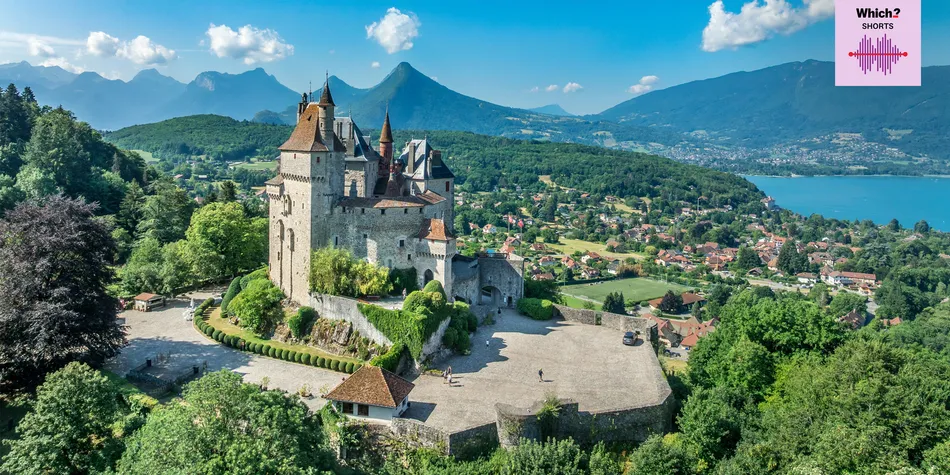
Every now and then, I'm rewarded with a peek of its cone-shaped, red-roofed turrets. I half expect a mane of golden hair to tumble from one of its Gothic windows.
Built by bishops in the year 1011, it's Slovenia's oldest castle. Despite the absence of a monarchy, the country has more than 500. This is largely a legacy of the Habsburg Empire, which ruled here from the 14th century until the end of the First World War.
Afterwards, Slovenia became Yugoslavia before declaring independence in 1991 – a source of huge national pride to this day.
At the top of the hill, the stone fortress unfurls over two levels, with sweeping views of the lake from the upper courtyard. There's also a Baroque chapel decorated with illusionist frescoes and a castle printing works, where I find a man diligently inking souvenirs with a replica Gutenberg press.
"Just choose your own corny message," he says – a ruefully honest sales pitch, it turns out. "Happiness is real only when it's shared," reads one.
The wine in the castle cellar is, thankfully, much easier to swallow. I sample a dry white and a velvety red from a family vineyard in the Vipava Valley, close to the Italian border.
Slovenia's Mediterranean climate, fertile soils, and indigenous grape varieties turn out some decent plonk – something you'll only discover if you visit.
The country is home to the world's oldest grapevine, planted more than 400 years ago in the Middle Ages. But the focus on small production means that most wines never leave the country. "Na zdravje" – Slovenian for "cheers" – is easily my most well-worn phrase of the trip.
The local wine is also low in sulphites, meaning less intense hangovers. No wonder they're unwilling to share.
Dine at the castle restaurant, Jezeršek, and your €18 castle entrance fee is waived. I arrive just before sunset and perch at the best table, where the floor-to-ceiling window yawns wide over the lake. The jagged peaks are bathed in soft pink before Bled is snatched by inky darkness. Just a smattering of lights twinkle on the shoreline.
Only then does my attention turn to the four-course tasting menu. Each dish is presented with a flourish, but the pumpkin gnocchi with parsnip cream and tender, slow-roasted lamb are the standouts.
It would be easy for Jezeršek to trade off its prime location alone, but the food – influenced by Slovenia's Italian, Austrian, and Balkan neighbours – is as delicious as it is elegant.
The next morning, I catch the bus to Bohinj, which takes the last victory lap of Lake Bled before trundling through picture-perfect Alpine hamlets fringed with spruce trees. The cabins, with steep gabled roofs and smoke curling from slate chimney pots, look straight out of Hansel and Gretel.
Stacks of firewood and colourful, heart-engraved shutters transport you even deeper into an enchanted world.
Yet, nothing prepares me for the show-stopping beauty when I alight 40 minutes later. Covering 318 acres, Lake Bohinj is around twice the size of Bled, and while it doesn't have a medieval castle as a cake topper, it's wilder and untouched.
Hemmed in by towering mountains, it sits within a glacial valley in the Triglav National Park, with just a fraction of the tourists, dog walkers, and runners you'll find circling Lake Bled.
Mount Triglav, Slovenia's highest peak at 2,864 metres and commemorated on the national flag, juts its three heads towards the heavens. Its reflection on the lake surface is so pristine, I'm momentarily disoriented. I watch the gentle lapping of the water, its aquamarine pigment blanching tie-dye as it meets milky-white sand. Only the mew of a buzzard swooping overhead reminds me which way is up.
The Bohinj glacier was quite the sculptor. Not only did it carve out the basins that would form Lake Bled and Bohinj, but its melt also cut through the bedrock in the central valley to help shape a deep canyon.
An easy two-hour, six-kilometre circular walk from nearby Stara Fužina village allows you to admire Mostnica Gorge from every angle.
The path starts at Devil's Bridge, a stone arch said to have been built by Lucifer in exchange for the soul of the first person to cross.
Carnivorous Alpine butterwort and lavender liverleaf wildflowers lead the way like scattered breadcrumbs, and I hear the first murmur of rushing water. Then I catch a glimpse of the gorge itself, a chiselled limestone ravine falling away to an emerald pool, like a portal to another world.
I follow the path through the moss-covered trees, stepping over gnarled tree roots to discover hollowed-out rock formations. The most celebrated is Slonček, or Little Elephant, in the shape of an elephant's head with its trunk arching into the water to drink.
Perhaps you're wondering what I wished for when I rang the bell in Bled. Swept up in the moment, I asked that one day I would return to Slovenia and see more of this breathtaking country.
And now, wowed by the natural wonders of Lake Bohinj, that desire has only grown stronger.
I will come back – either God or a budget airline will make it happen.
James Rowe: That brings to an end another podcast from Which? There's loads more for you to read about everything we discussed today, just head to the episode description for more useful everyday advice.
There, you'll also find an exclusive offer for podcast listeners like you to become a Which? member for 50% off the usual price, giving you access to our product reviews, our app, 1-on-1 personalized buying advice, and every issue of Which? magazine across the year.
Plus, your membership helps us to make life simpler, fairer, and safer for everyone.
If you'd like to know when we release a new episode, then make sure you press subscribe wherever you're listening. That way, you can be one of the first to listen.
And for any questions, comments, or anything in between, follow us on social media @WhichUK or email us: podcast@which.co.uk.
Goodbye.